
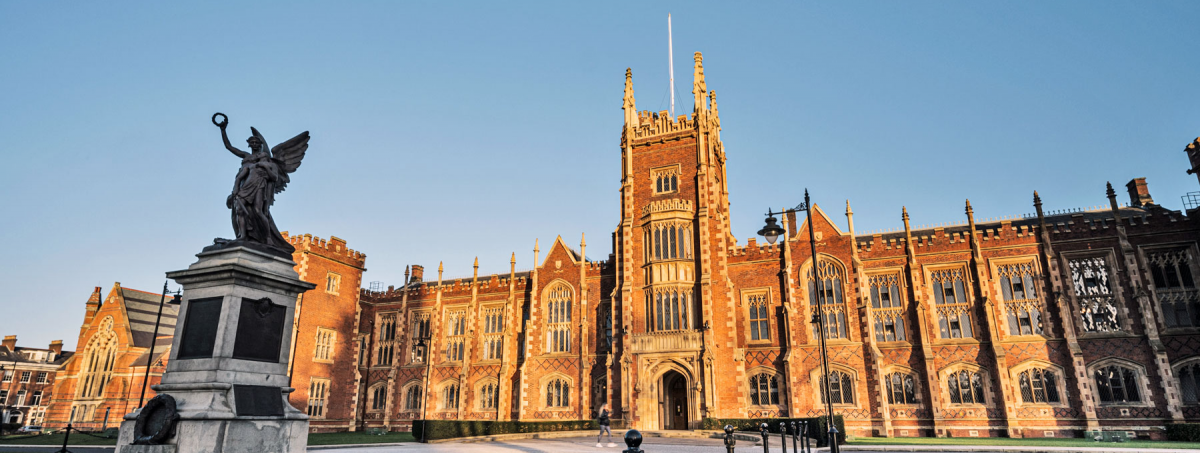
Queen’s University Belfast has officially opened its almost £100 million Advanced Manufacturing Innovation Centre, giving manufacturers access to AI, robotics, automation and digital twins without building those capabilities in-house.
The centre matters to the sector because companies can test technologies there before committing to their own investment.
The Factory of the Future at Global Point Business Park in Newtownabbey is a 10,500 square metre open-access facility that has been operating since April 2026. Led by Queen’s in partnership with industry and Ulster University, AMIC also operates from the NIACE building on Airport Road in Belfast.
AMIC builds on more than 55 years of industry-focused innovation at Queen’s through the Northern Ireland Technology Centre, the Polymers Processing Research Centre and the Northern Ireland Advanced Composites and Engineering Centre. Its engineers already work across robotics and automation, advanced materials, digital twins, AI, advanced metrology and machining.
Projects also cover energy efficiency, renewable energy and sustainable use of resources, and the centre was developed with companies and industry partners shaping its capabilities. The facility takes a technology-agnostic approach to Industry 4.0, offering a purpose-built environment designed around industry needs.
By 2050, AMIC is expected to create up to 1,500 jobs across Northern Ireland, contribute £1.3 billion to the economy and support the training of 300 apprentices. AMIC will host the Matrix Polymers event on 21 and 22 October.
Professor Sir Ian Greer, President and Vice-Chancellor of Queen’s University Belfast, said: “Universities have an important role to play in supporting local businesses to innovate and adapt, and by bringing together academic expertise and industry experience, AMIC enables us to work directly with manufacturers to address real-world challenges.”
The structural driver is the cost and risk of adopting advanced manufacturing technologies, which a shared, open-access facility reduces by letting firms test AI, robotics and digital twins before investing.
For the sector, the centre shows universities positioning themselves as shared innovation infrastructure for manufacturers, particularly firms that cannot build AI and automation capability in-house.
Source: edtechinnovationhub.com / we-are-amic.com / 4ni.co.uk / northernirelandchamber.com







.png)