

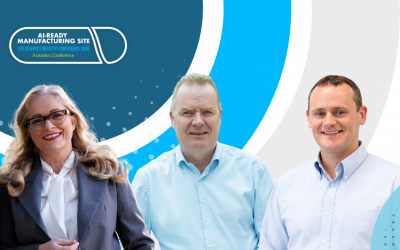
Colm Bambury, Director of Digital Technology at Amgen, discusses the practical application of artificial intelligence across life sciences manufacturing ahead of the Life Sciences Industry Conference 2026.
Bambury works across manufacturing systems, automation, manufacturing execution systems, data and analytics, applying technology and AI across Amgen’s global GMP regulated network. His experience places him at the intersection of digital transformation and manufacturing operations, where AI must work within established processes, systems and regulatory requirements.
Bambury highlights the importance of identifying specific operational challenges before introducing AI. “AI can help improve reliability, planning, throughput and the speed of decision-making,” he says, while noting the need to connect technology investment with tangible manufacturing requirements.
Effective implementation also depends on clear responsibilities across the organisation. Bambury identifies five considerations that need to be established: “the problem being solved, who owns the data, what level of risk is acceptable, where human accountability sits and who will operate the capability after launch.”
His approach places trusted data at the centre of AI adoption. Rather than measuring progress through the introduction of new technology alone, Bambury describes an AI ready manufacturing environment through the way employees interact with information and make decisions.
“What would feel different is how quickly people can move from a question to a trusted answer and then to action,” he says. This requires organisations to make data accessible, contextualised and secure while establishing appropriate governance around AI enabled processes.
Human involvement also remains important as AI becomes more integrated into manufacturing operations. Bambury emphasises the need for employees to understand AI outputs and recognise when those outputs should be questioned or escalated, particularly within regulated environments where accountability cannot simply be transferred to technology.
The conference will explore these practical considerations through four themes covering responsible AI, scaling AI from pilot to production, people and organisational change, and the AI ready enterprise. The agenda focuses on AI across manufacturing, quality, supply chain, digital transformation and process optimisation.
Bambury is one of 13 speakers announced to date for the Life Sciences Industry Conference 2026, alongside keynote speaker William Fahey, Data Science Lead at Pfizer. The Life Sciences Industry Conference 2026 takes place on 22 October at the Crowne Plaza, Santry, Dublin.
Visit the official Life Sciences Industry Conference 2026 website to book your place and explore the full AI manufacturing agenda.






.png)